Meet an ancient member of birds' family tree
Thursday, June 15, 2006
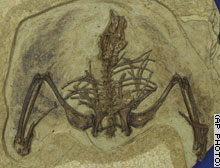
WASHINGTON (AP) -- The first detailed look at the ancestor of modern birds -- a grebe-like waterbird that would look normal even today -- was shown off Thursday by scientists who discovered fossil remains in a remote lake bed in China. "A world lost for more than 100 million years was being revealed to us," as layers of mud were peeled back like the pages of a book, said Hai-lu You of the Chinese Academy of Geological Sciences. What they found is being called the missing link on the evolution of birds, a creature that lived in northwest China and is the earliest example of modern birds that populate the planet today. Before the scientists' discovery, reported in Friday's issue of the journal Science, the only evidence for this creature -- Gansus yumenensis -- was a single, partial leg discovered in the 1980s. Now researchers have dozens of nearly complete fossils of Gansus, said a beaming Matt Lamanna of the Carnegie Museum of Natural History in Pittsburgh. "Most of the ancestors of birds from the age of dinosaurs are members of groups that died out and left no modern descendants. But Gansus led to modern birds, so it's a link between primitive birds and those we see today," Lamanna said. Previously there was a gap between ancient and modern species of birds, and "Gansus fits perfectly into this gap," added Jerald D. Harris of Dixie State College in Utah. It was about the size of a modern pigeon, but similar to loons or diving ducks, the researchers said. One of the fossils even has skin preserved between the toes, showing that it had webbed feet. "We were lucky far beyond our expectations" in finding these fossils, added You. "Gansus is the oldest example of the nearly modern birds that branched off of the trunk of the family tree that began with the famous proto-bird Archaeopteryx," said Peter Dodson of the University of Pennsylvania. The remains were dated to about 110 million years ago, making them the oldest for the group Ornithurae, which includes all modern birds and their closest extinct relatives. Previously, the oldest known fossils from this group were from about 99 million years ago. The fact that Gansus was aquatic indicates that modern birds may have evolved from animals that originated in aquatic environments, the researchers said. "Our new specimens are extremely well preserved, with some even including feathers," Lamanna said. "Because these fossils are in such good condition, they've enabled us to reconstruct the appearance and relationships of Gansus with a high degree of precision. They provide new and important insight into the evolutionary transformation of carnivorous dinosaurs into the birds we know today." The remains were found in an ancient lake bed near the town of Changma. "We went to Changma hoping that we'd discover one, maybe two, fragments of fossil birds," he said. "Instead, we found dozens, including some almost complete skeletons with soft tissues." The new fossil material "is remarkable for its excellent preservation. ... The new fossils demonstrate that Gansus clearly is a bird that spent much of its life looking for food in water," said Hans-Dieter Sues, associate director for research and collections at the Smithsonian's National Museum of Natural History. Gansus is an additional "link in a long chain of intermediate forms between Archaeopteryx, the oldest known bird from the late Jurassic, and modern birds," said Sues, who was not part of Lamanna's research team. Funding for the research was provided by the Discovery Quest program for The Science Channel, Carnegie Museum of Natural History, Dixie State College of Utah, the Chinese Geological Survey and the Ministry of Science and Technology of China. At one point during the field work, Lamanna told his colleagues he would eat a duck foot if they found the fossil they were seeking while the television camera crew was still there. So, did they? "It tasted sort of like chicken, but real rubbery," he recalled. |
» go to Atheists of Silicon Valley Science page «
» go to Atheists of Silicon Valley home page «