|
Photo
by Edwin Kagin |
Fundamentally
Aware Bringing
America’s Own Religious Extremism to the Forefront |
|
|
Volume 1, Number 8 |
|
SPECIAL
OFFER Small
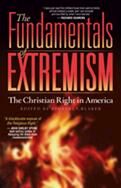
supply of brand new copies of THE
FUNDAMENTALS OF EXTREMISM
with slightly damaged covers Hardcover
$19.95 (regular $24.95) Paperback
$12.50 (regular $15.95) Call
toll free (866)
639-2678 while
they last! “A
blockbuster exposé
of the activities of the Religious
Right,” says JOHN SHELBY SPONG best-selling author of Rescuing the Bible from Fundamentalism
Click
image for details or visit your favorite online bookseller. “I
have just read this brilliant book from start to finish, almost
without a break, and I am stunned and horrified by what I have
learned,”
says RICHARD DAWKINS author of Unweaving
the Rainbow: Science, Delusion and the Appetite for Wonder The
Fundamentals of Extremism is
now listed in The
|
From
the publisher
Welcome to issue 8 of Fundamentally Aware. If you’re not yet a subscriber to my complimentary e-newsletter, be sure to sign up. You’ll find details in the lower left column. The national media blitz for The Fundamentals of Extremism: the Christian Right in America begins this August. I’ve started scheduling book signings, so you can see when I’ll be visiting your area at http://www.newbostonbooks.com/Tours%20and%20Events.htm This will be updated regularly, so check back if your city isn’t yet listed. Now
for the not-so-good news. For
the next few months, I’ll be publishing my Fundamentally
Aware e-newsletter only once, rather than twice, a month.
In this issue read the latest in the school voucher saga in “Who are the Voucher Visionaries?” And tying in with this topic, read an excerpt from The Fundamentals of Extremism. As always, please feel free to share your comments with me. Kimberly Blaker Contents 1. The Voucher Debate 2. Politically Incorrect
3. Who are the Voucher Visionaries?
A look inside 4. Conservative Christian Views on Education The
Voucher Debate The
following is excerpted from Chapter 6: The Purgation of the First
Amendment by John M. Suarez in The Fundamentals of Extremism. Public
education has been the main target of the radical religious right from
the beginning. This is understandable because a vibrant and effective
system of public education is incompatible with the establishment of a
theocracy. The radical religious right has concluded it is necessary
to malign public education as a step toward the goal of weakening
through the denial of funding. Despite inherent constitutional flaws
and the perennial absence of popular support, school vouchers continue
to be promoted in a variety of settings and in different packages.
Beginning in the state of Despite
the poor showing of vouchers in public referenda and in state
legislatures, the persistent efforts of their proponents culminated in
the United States Supreme Court's decision to revisit the issue 30
years after its last previous undertaking. In the case of Zelman v.
Simmons-Harris[ii],
at the end of the 2002 judicial year, the Court concluded that
vouchers were constitutional in a Although there were positive elements to be found in the decision, separationists had to come to grips with the fact that the issue of constitutionality, at least for now, had been disarmed. The decision, as expected, opened the flood gates in states and municipalities. Within two months it was reported that legislators in as many as 20 states were gearing to introduce voucher bills.[iv] . . . The
Zelman decision resurrected for consideration and discussion a couple
of earlier, seldom mentioned, Supreme Court decisions. In the 1973
Nyquist decision[v],
the voucher program was struck down because it created incentives for
parents to select religious schools instead of secular ones, and it
provided assistance only to children attending private schools. Later
in 1973, in the Sloan decision[vi],
the Court disallowed another program nearly identical to the one in
Nyquist. The Zelman majority discussion articulated that any voucher
program must provide adequate public and secular options to survive
constitutional scrutiny. With
the issue of constitutionality removed at the federal level, voucher
opponents turned their focus to the states. A review of state
constitutions revealed that in at least 37 of them there is language
that bars tax funds for sectarian institutions. In most of them, the
critical language resides within sections labeled "Blaine
Amendments." As expected, these sections have become targets of
the radical religious right and other voucher proponents, under the
primary argument that they reflect nineteenth century
anti-Catholicism. The strategies for doing away with the Blaine
Amendments include "persuading state courts to interpret them
narrowly, having federal courts declare them in conflict with the
First Amendment, and persuading voters to repeal them through ballot
referenda.”[vii] It
did not take long, after the Zelman decision, for a court in Read
more on this issue in John Suarez’s chapter “The Purgation of the
First Amendment” in The
Fundamentals of Extremism: the Christian Right in America. |
|
Politically
Incorrect “All
things equal, I would prefer to have a child in a school that has a
strong appreciation for the values of the Christian community, where a
child is taught to have a strong faith
|
|
|
Click
image Fundamentally
Aware Published
by Kimberly
Blaker Editor/coauthor The
Fundamentals of Extremism: the Christian Right in To
subscribe: Send
your name and email address to:
Notice
of confidentiality.
Your
name, email address, and contact information
will not be sold or disclosed to anyone. It will be used
strictly for purposes of distributing the Fundamentally Aware
newsletter. You will not receive any other email from New Boston
Books, Inc. To
Unsubscribe: Send
your name and email address with “Unsubscribe” in the subject line
to: |
Who
are the Voucher Visionaries? A look inside In
May, Americans United for Separation of Church and State (AU) filed
suit over a recently approved Despite
the flawed decision of the conservative high court, most Americans
consistently oppose school voucher programs, not because we don’t
want to improve educational opportunities for all children, but
because of ample arguments against them; the ultimate
destruction posed by vouchers hardly warrants their implementation.
But regardless of their devastating effects, it doesn’t
prevent those who would erode the Separation Clause of the First
Amendment and undermine the education of public school children from
repeated attempts at legislating such programs. Of
particular concern is a reintroduced federally funded voucher proposal
for It’s
common knowledge that the majority of private schools in the Unlike the reasons many of us support school of choice, such as for varied learning environments, few religious schools operate with such needs in mind. Many have fewer offerings than public schools for learning disabled or gifted students. And unlike private secular schools established to offer alternative approaches to learning, many conservative religious schools go the opposite extreme, requiring even more rote learning than public schools.
Likewise, the parents of these children (those enrolling their children in fundamentalist Christian schools), are generally well-aware of the nature of the religious teachings and often send their children solely for such purposes. In 1947, the Supreme Court ruled in Everson v. Board of Education that, “Neither [the Federal Government or the state] can pass laws which aid one religion, aid all religions, or prefer one religion over another. . . . No tax in any amount, large or small, can be levied to support any religious activities or institutions, whatever they may be called, or whatever form they may adopt to teach or practice religion. . . .” There’s no question that a substantial number of vouchers would fall squarely into those areas that this Supreme Court ruling prohibits. The fact that private and parochial schools are not obligated to meet the same criteria as public schools for assuring a full and satisfactory education and to assure children’s physical and emotional well-being is an even greater blow to the idea of siphoning tax dollars from public institutions. Of course, where there’s a will, there’s a way. In recent years, fundamentalists have found ways around the voucher system. Although many charter schools have originated for valid reasons, many more have been underhandedly formed by Christian conservatives to institute their religious teachings through government subsidies. I recognize that not all parents who support vouchers do so for religious purposes. Many are truly seeking better opportunities for their children, especially those in poor districts where private schools do sometimes outperform the public. School choice and better educational opportunities is a serious issue that needs addressing. But vouchers only partially band-aid the problem at the expense of other students while violating our Constitution in doing so. Because many proponents of vouchers are minorities, the long-term effects could be monumental even to those most in need of vouchers, as an uncompromised Constitution and Bill of Rights is what protects their civil rights. Kimberly
Blaker is editor and coauthor of The
Fundamentals of Extremism: the Christian Right in Conservative
Christian Views on Education While
a vast number of http://www.family.org/welcome/press/a0015995.cfm What’s
Dr. Edward Hindson’s take on the pluralism that’s forced on http://www.nljonline.com/jan02/hindson.htm
Read
the Christian Educators Association International’s “Declaration
for Public Education.” http://www.ceai.org/declaration.html
|

[i]
“Should You Pay Taxes to Support Religious Schools?,” Faith and
Freedom Series, Americans United for Separation of Church and State.
[ii]
Zelman v. Simmons-Harris, 122
[iii]
Rob Boston, "Supreme Mistake," Church & State,
July/August, 2002, 4.
[iv]
Rob Boston, "Voucher Victory," Church & State,
September, 2002, 7.
[v]
Committee for Public Education and Religious Liberty v. Nyquist, 413
[vi]
Sloan v. Lemon, 413
[vii]
Rob Boston, "The
[viii]
Bush v. Holmes, 767 So. 2nd 668 (Fla. App. 2000), review denied, 790 So.
2nd 1104 (2001), opinion on remand (Fla. Cir. Ct.,